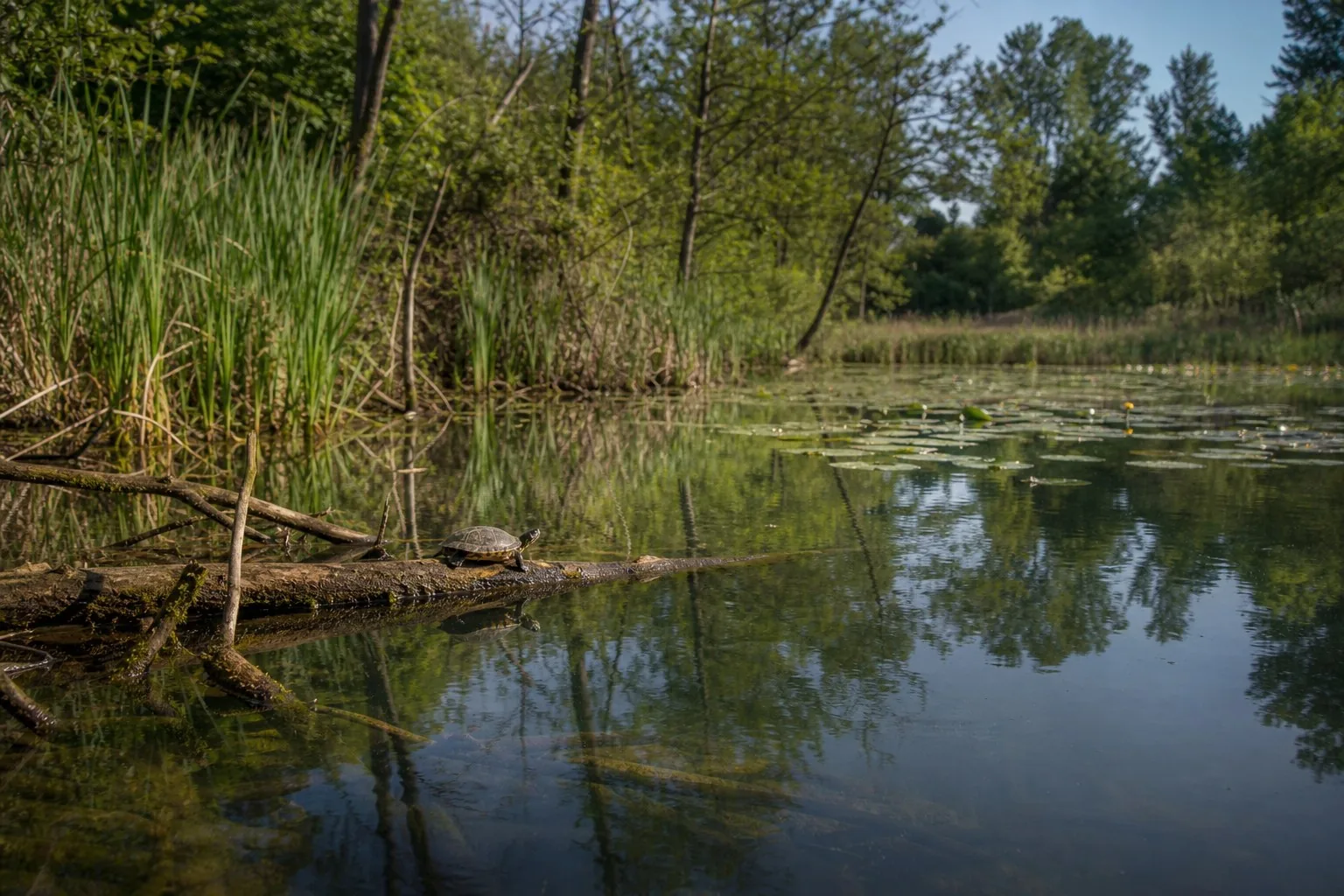
The essential answer
What is the ideal habitat for an aquatic turtle?
An environment sized for the species and its adult dimensions, where the animal can choose to swim, rest, hide, leave the water completely, dry off and reach a suitable temperature. Stable water conditions, UVB light, warmth, safety and space form a single system.
The key word is choice. Reptiles regulate many aspects of their internal balance by moving between different microenvironments. A uniform, cold tank with no shelter restricts the animal; a well-designed habitat restores some of the choices it would have in the wild.
Aquatic area
Must allow the species’ typical movement, provide resting points and maintain water quality that supports welfare.
Basking area
Must be accessible, stable and completely dry, with enough space to support the whole body without competition.
Light and heat
Create a gradient the animal can use. Measure temperatures where the animal actually spends time, not in an arbitrary corner of the room.
Safety
Edges, cables, heaters, furnishings and fences must prevent escapes, burns, falls, entrapment and contact with predatory household pets.
The principle: observe nature before designing
An aquatic turtle needs more than simply to be ‘inside’ a container. It must be able to move, swim, surface, dry off, regulate its temperature, seek shelter, feed appropriately and live in a stable environment.
For many species, particularly adults, a home aquarium can be a restrictive compromise. It may not always be avoidable, but it should never be conceived as a decorative or minimal setup. The animal’s needs come first; the container comes afterwards.
The ideal habitat: what it should offer
Genuine space
Not just litres of water, but surface area, appropriate depth, places to explore and room to move.
Sunlight or appropriate lighting
Thermoregulation and UVB exposure are part of health, not decorative extras.
A dry basking area
The animal must be able to leave the water completely, dry off and warm up without stress.
Stable water conditions
Filtration, water changes, temperature and hygiene reduce infections, unpleasant smells and chronic stress.
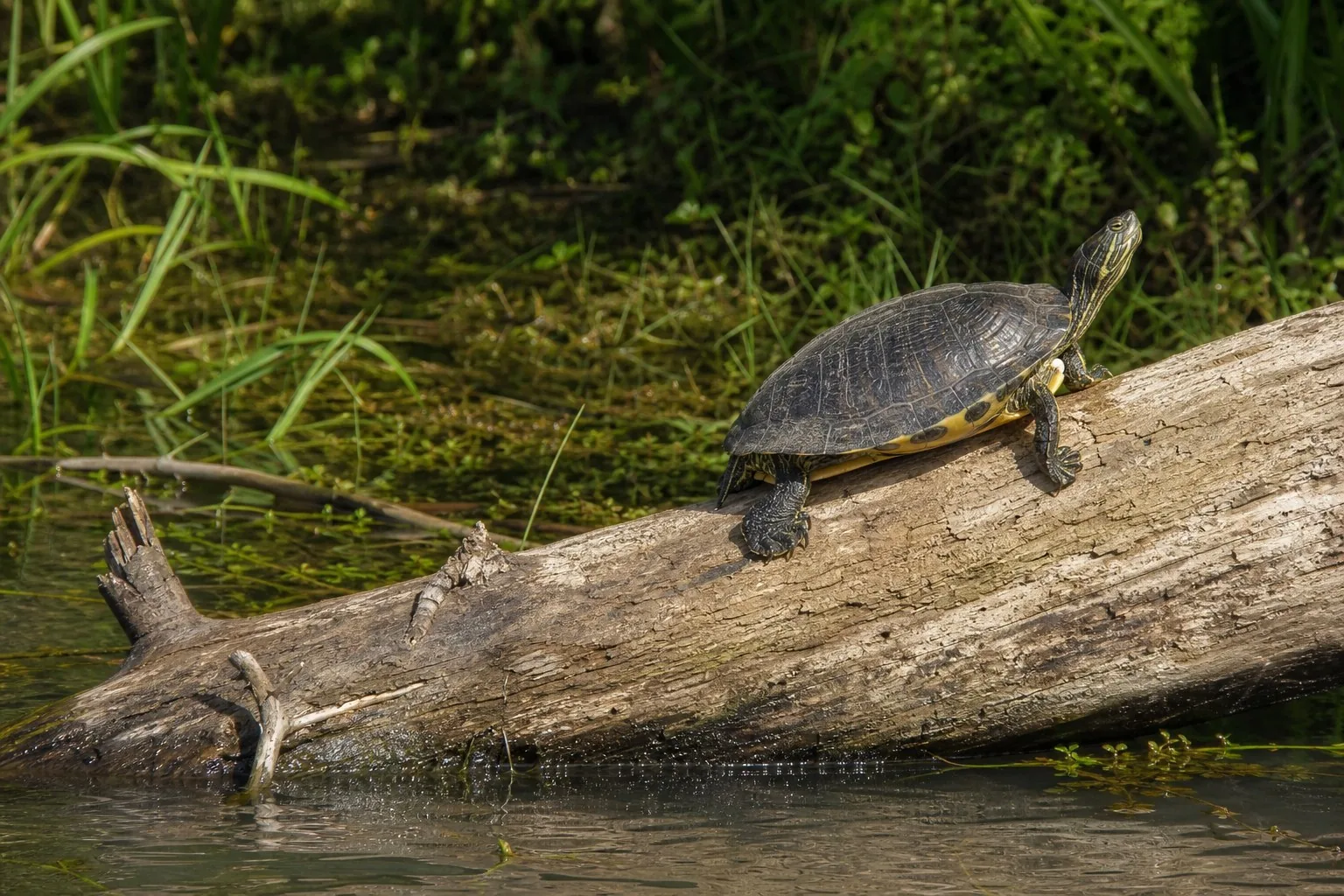
For some species and in some circumstances, a safe, well-designed outdoor pond can be more appropriate than an indoor tank. But ‘outdoors’ does not mean release into the wild: safety, legality, escape prevention, prevention of uncontrolled breeding and assessment of the climate are all essential.
Design around functions, not accessories
A suitable habitat is not simply a collection of things bought online. It is built around biological functions that must be supported every day: swimming, breathing easily, leaving the water, drying off completely, warming up, receiving UVB, hiding, exploring and not living in constantly dirty water.
Volume and surface area
The turtle must be able to swim and turn without constantly bumping into glass, furnishings or the filter. Adult size matters, not its size in the shop.
Temperature gradient
Water, air and the basking area must allow choice. A completely uniform environment prevents thermoregulation.
A proper basking area
Must support the adult animal, stay dry, avoid injuring feet or plastron and allow exposure to warmth and UVB.
Thoughtful enrichment
Footholds, safe plants, shelters and routes reduce stress, but must not create traps, abrasions or places where the animal can get stuck.
The best test is to ask whether each feature serves the animal or just us. An impressive but sharp root, swallowable gravel or an unstable island makes the environment riskier, not more natural.
Parameters to check: what the eye cannot see
Many health problems begin before water looks dirty. Temperature, water quality, UVB and habitat stability must be measured, not guessed. Exact values depend on species, age and season, but the method is the same: a reliable thermometer, regular checks and gradual adjustments.
- Water temperature: must be stable and appropriate for the species; water that is too cold can contribute to weakness, loss of appetite and respiratory problems.
- Basking area: must be warmer than the water and completely dry, so the animal can choose when to warm up and dry off.
- UVB: lamps and distances must follow the requirements of the product used; many lamps lose effectiveness before they visibly stop working.
- Water: ammonia, nitrite, nitrate, odour, cloudiness and organic build-up need monitoring. Smelly water is not ‘normal’: it is a warning about the care routine.
- Photoperiod: light and darkness need a consistent routine; irregular or continuous lighting disrupts behaviour and biological rhythms.
A closer look
Water quality: understand the biological cycle, do not rely on clarity
Clear water is not necessarily biologically safe. Food remains and waste produce nitrogen compounds; in a mature filter, microbial communities gradually convert the more toxic compounds. This balance requires time, oxygenation, suitable filter media and maintenance that does not constantly reset the system.
A filter does not replace water changes, and water changes do not replace a filter. The right frequency depends on volume, the number and size of animals, feeding and biological maturity. Reagent tests, records and observation of trends tell you more than cleaning only when an unpleasant smell appears.
Using a tank or aquarium: be honest about the compromise
If the animal lives indoors, its enclosure must recreate natural functions, not simply hold water. The tank must allow swimming, drying off, warming up, UVB exposure and hygienic maintenance.
- Size the tank for the adult animal, not its size when bought.
- The filter must be much more capable than one used for small fish.
- The basking area must remain dry and stable.
- UVB lamps have a limited effective lifespan and need replacing.
- Safety matters: escapes, falls, cables, overheating and forced cohabitation are real risks.
The aim is not to make the tank most attractive to us, but most suitable for the animal. An enclosure that looks tidy but offers few functions is not a good habitat.
Filtration and maintenance: stability before spectacular cleaning
An aquatic turtle produces a substantial organic waste load. That makes the filter part of the habitat, not an accessory. It must work both mechanically and biologically, trapping debris while supporting a bacterial colony that helps convert nitrogen compounds.
A common mistake is aggressively washing everything, emptying the tank completely and starting from scratch each time. This may look clean, but it makes the environment unstable. Regular partial water changes, waste removal, filter-media checks and thoughtful cleaning are better, avoiding sudden changes in temperature and water quality.
- Remove uneaten food and visible debris before they break down.
- Do not overcrowd: more animals mean more competition, more waste and greater health risks.
- Protect the filter intake if the animal is small or there is a risk of entrapment.
- Treat smells and cloudiness as signs to review your care routine, not unavoidable annoyances.
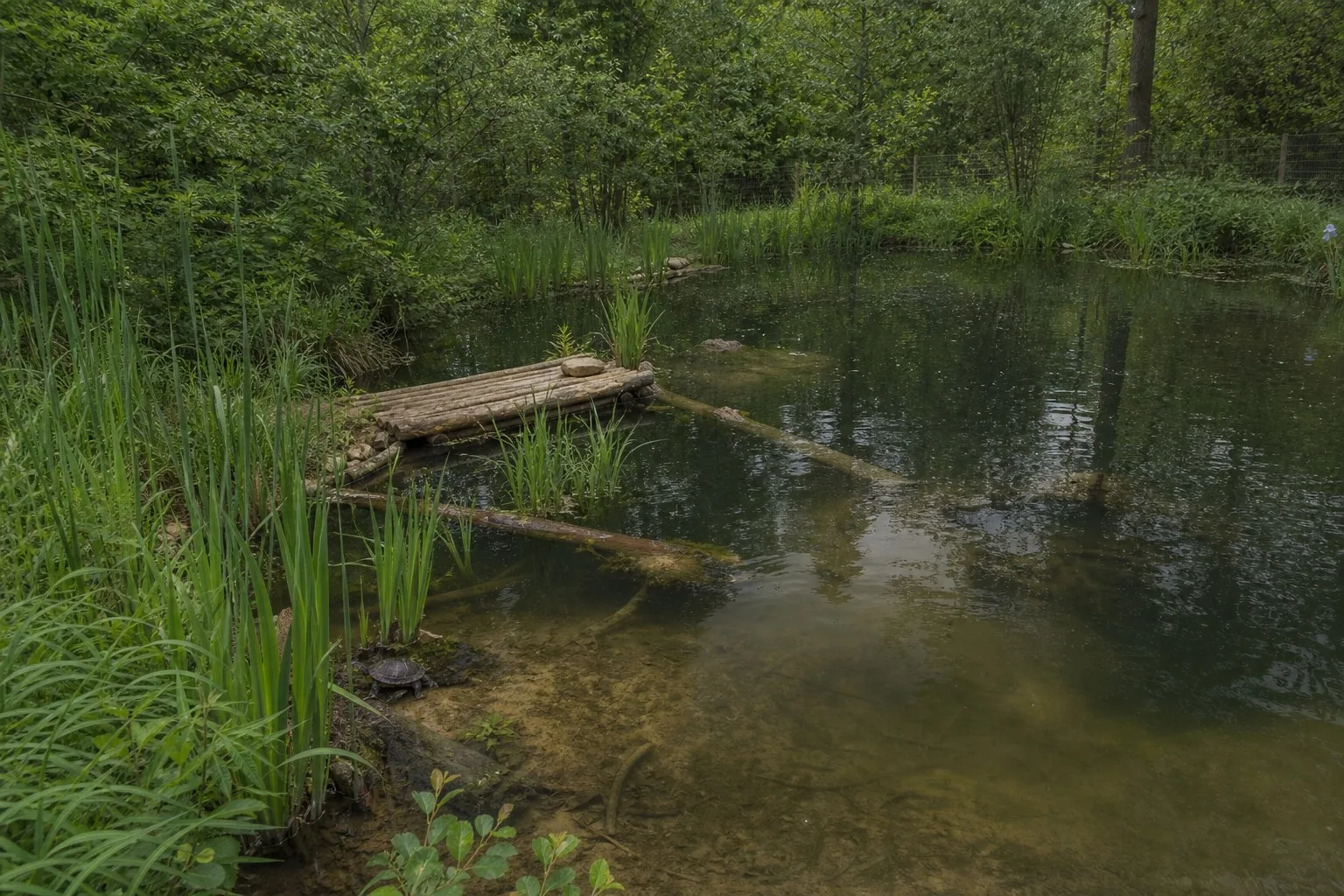
Outdoor ponds: when they may be better — and when they are not
For some adults, where climate and legal conditions are suitable, a carefully designed private pond can offer more movement, natural light and stimulation than an indoor tank. But a pond is not a shortcut: it is a substantial, lasting responsibility.
It requires escape-proof fencing, buried where necessary, predator protection, safe depths and banks, sun and shade, no access to natural waterways, egg management, health checks and verification of the species’ legal status. If any of these is missing, a pond can be more dangerous than a tank.
Practical differences between species
Trachemys and Pseudemys
Often need plenty of space, powerful filtration and a sturdy basking area. As adults, they may outgrow an enclosure designed for a juvenile.
Graptemys
Clean water, sufficient depth and appropriate basking conditions are essential. Water quality is particularly important.
Sternotherus
Small size does not mean a bare environment is acceptable. Footholds, resting areas and carefully considered depth are needed.
Pelomedusa
Do not automatically copy setups for North American species. Temperature, depth and the dry area must be planned for the species concerned.
Apalone and softshell turtles
Need particular attention to substrate, abrasions, water quality and space. Makeshift environments, sharp furnishings or forced cohabitation are especially unforgiving for these animals.
Chelodina, Emydura and non-Mediterranean species
Do not care for them on autopilot. Geographic origin, behaviour, temperature and diet may differ greatly from familiar North American species.
Common mistakes to avoid
- Buying the animal before designing its habitat.
- Using tiny tanks with decorative islands.
- Confusing a private pond with release into the wild.
- Failing to provide UVB, warmth and a dry basking area.
- Keeping incompatible animals or animals of different sizes together.
- Cutting costs on the filter and compensating with stressful cleaning.
Sources and further reading
Numerical guidance must be adapted to the species and checked with a vet experienced in reptiles. To explore husbandry principles further, consult identifiable veterinary and taxonomic sources.
If this page has helped you see the tank differently, it has already provided something valuable. To help others do the same, you can support the project.
Frequently asked questions
How big should an aquatic turtle’s tank be?
It should be planned around the adult size and behaviour of the species, not its size when purchased.
Is a dry basking area always necessary?
For species that bask and dry off, yes: it must be stable, dry and properly heated.
Do aquatic turtles need UVB light?
In most indoor setups, yes, for metabolism, calcium use and general health.
Can a small aquarium be used temporarily?
Only as a short-term, closely monitored emergency measure. It must not become the usual home.
Check feeding and health too
Habitat, diet and preventive healthcare are three parts of the same balance.
Read about feedingEditorial note
Visual approach: The naturalistic images are editorial reconstructions created to illustrate habitat functions. They do not identify a species or represent universally applicable dimensions.
Disclaimer: This guide is for information only and does not replace advice from a vet experienced in reptiles, the relevant authorities or a legal adviser where necessary.