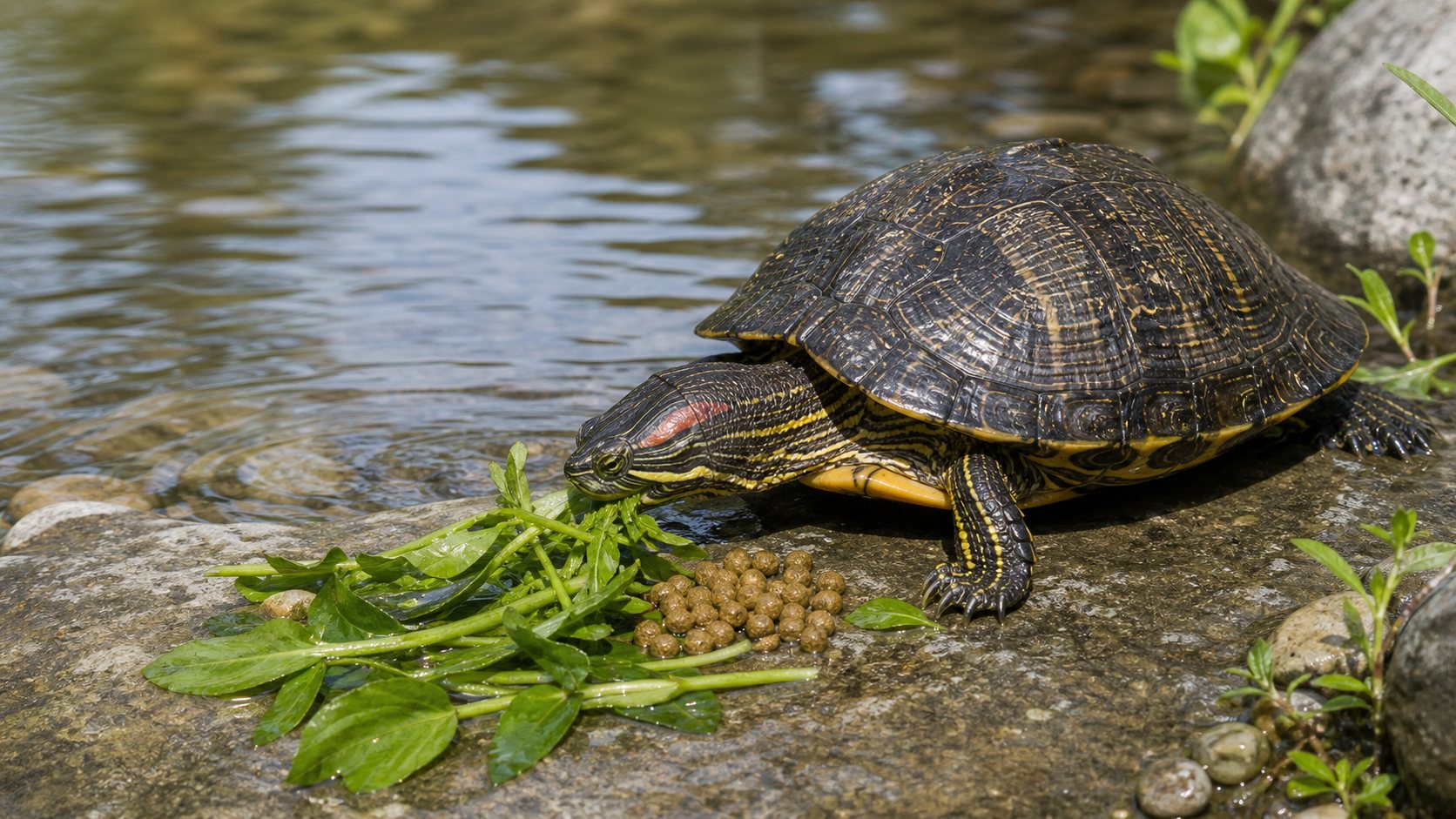
The essential answer
What should an aquatic turtle eat?
It needs a varied diet suited to its species, age, the season and its health. Many aquatic turtles are omnivorous, but the balance between plant and animal foods varies greatly: there is no universal menu, and dried shrimp are not a complete feed.
Good feeding means looking at the whole animal, not just its appetite. A turtle may eagerly accept an unbalanced diet. Its growth, weight over time, behaviour, shell development and water quality tell you more than how much it eats at one meal.
Species
Beak shape, habitat and feeding behaviour help guide the diet. An adult Pseudemys should not be fed as though it were a strongly carnivorous species.
Age
In several species, juveniles eat a higher proportion of animal food and adults eat more plant matter, but the transition is not the same for all turtles.
Environment
Temperature, UVB and opportunities to move affect digestion, metabolism and calcium use.
Getting the amount right
Feeding frequency and portions should be assessed against growth and body condition. Feeding as a gesture of affection can become overfeeding.
Before buying food, ask yourself one question
What would this turtle eat in the wild? What would it need to thrive in its habitat? That question changes how we choose food: we start with the animal’s biology, not the shop shelf.
If we cannot let it live in its natural environment, we should at least avoid designing its diet around our own convenience. A turtle with a good appetite is not necessarily well nourished: some mistakes cause problems slowly, such as uneven growth, obesity, a fragile shell, deficiencies or water that becomes dirty too quickly.
Diet does not work in isolation: calcium, UVB, temperature and water quality are connected. Even the best food is less effective in an unsuitable environment.
The right diet depends on species, age, temperature and season
There is no universal diet for an ‘aquatic turtle’. A growing juvenile, an adult female, a mainly herbivorous species, a more carnivorous species and a debilitated animal have different needs. Temperature and light also affect appetite, digestion and metabolism.
A sound approach is not to chase a single miracle food, but to build a diet that matches the animal’s biology and an environment that allows it to digest, absorb calcium and move. If the water is cold, the basking area is unsuitable or the UVB lamp is old, nutrition becomes less effective.
Make dietary changes gradually and observe the response, appetite, weight, behaviour and water quality. Occasionally refusing food is not always an emergency; persistent loss of appetite, weight loss or lethargy, however, require veterinary assessment.
A closer look
Nutrients, UVB and temperature: why food cannot work alone
Protein, fats, fibre, vitamins and minerals serve different purposes and should come from a balanced diet, not random supplementation. In ectothermic reptiles, environmental temperature also affects digestion and metabolism; for many species, UVB exposure contributes to processes involving vitamin D and calcium use.
| Component | Why it matters | Common mistake | Responsible approach |
|---|---|---|---|
| Protein | Supports growth and tissue maintenance, with needs varying between species and life stages. | Assuming ‘more protein’ means ‘better health’ and using kitchen meat as a staple. | Choose appropriate sources and include them in proportions suited to the animal. |
| Plant matter and fibre | For many adult omnivorous or herbivorous species, these support a diet closer to natural feeding behaviour. | Continuing the high-protein menu used for juveniles throughout the animal’s life. | Offer a variety of safe vegetables and plants, and observe what is actually eaten. |
| Calcium and phosphorus | Contribute to mineralisation of the skeleton and shell within a complex metabolic balance. | Adding calcium without addressing UVB, temperature or the overall diet. | Assess food, light, heat and growth together; do not guess supplement doses. |
| Vitamins | Needed in appropriate amounts, but both deficiencies and excesses can be harmful. | Using concentrated supplements to treat a symptom without a diagnosis. | Build a varied diet first; supplement only on qualified advice. |
| Water | For many aquatic species, it is the medium in which they feed, move and excrete. | Leaving leftovers to decompose or routinely feeding in containers that cause stress. | Remove leftovers and adapt feeding and maintenance to the individual’s behaviour. |
A general nutrition guide explains principles and differences; a clinical diet for an ill, abnormally growing or debilitated animal must be devised by a vet after assessing its species, environment and body condition.
Useful food groups
Plant foods
Essential for many adult species and those with omnivorous or herbivorous tendencies.
Appropriate protein sources
Particularly useful during growth or for more carnivorous species, but too much is a problem.
Calcium
Needed alongside UVB and proper temperature management. It is not a magic powder to add at random.
Quality pellets
Can be a practical addition, but should not become the entire diet. Choose them to suit the species, size and age.
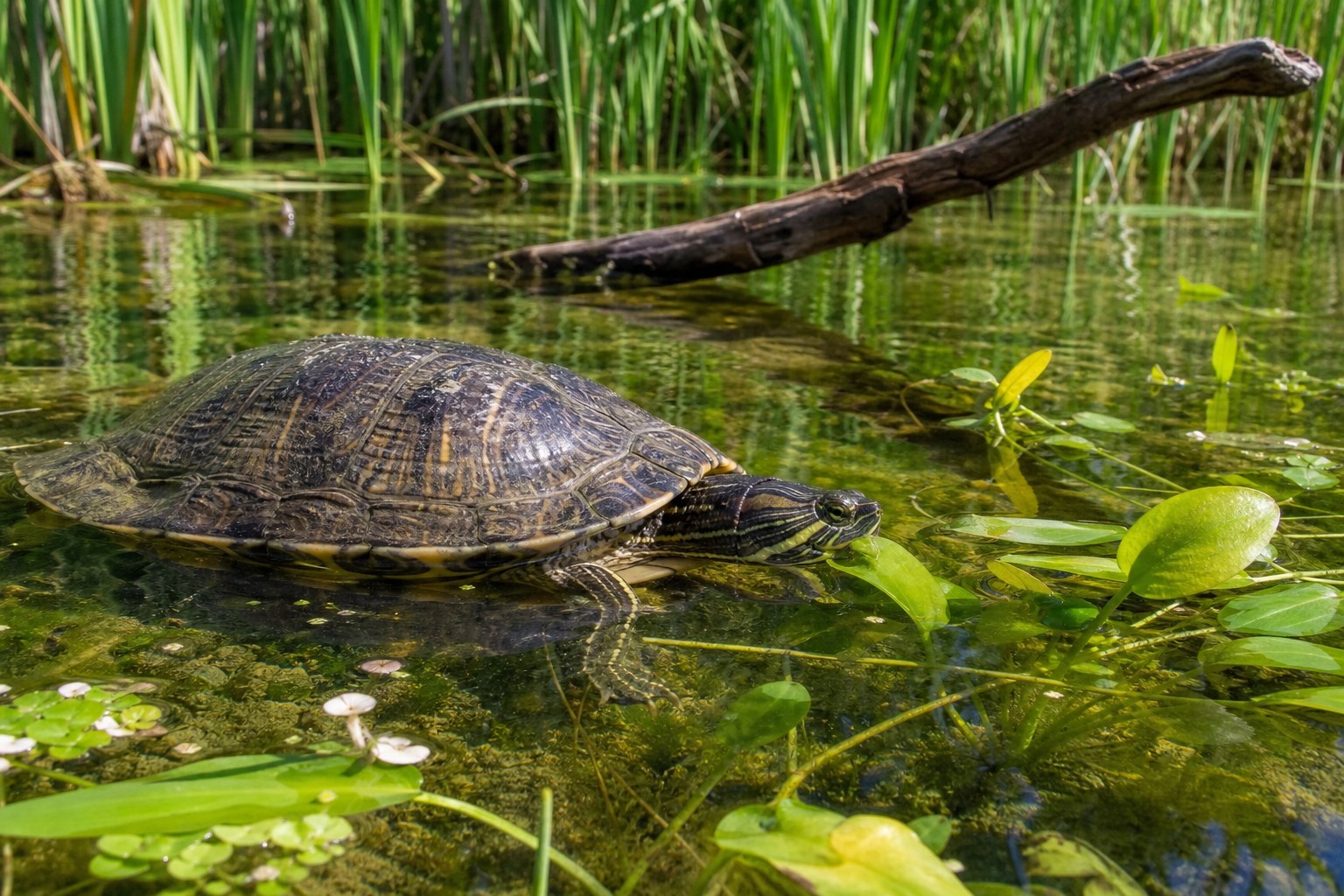
Vegetables and aquatic plants
For many omnivorous species, especially adults, plant matter helps avoid unnaturally high-protein diets. Suitable greens and vegetables, safe aquatic plants and untreated plant foods are preferable to seasoned or salty human foods. Choose carefully: if you cannot identify a plant, do not offer it.
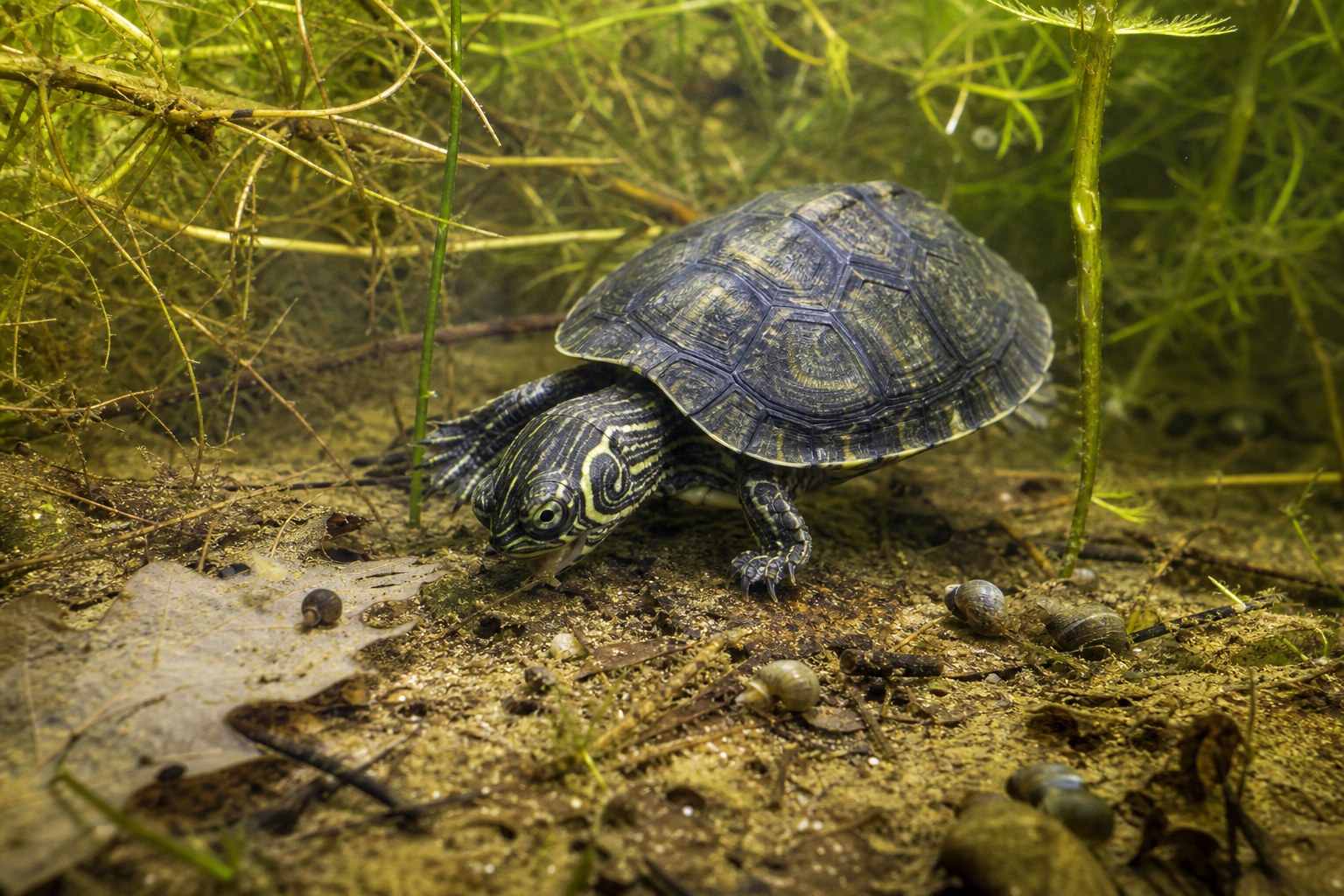
Appropriate protein sources
Protein matters, especially during growth and for more carnivorous species, but quality matters more than quantity. Invertebrates, suitable small aquatic food items and whole prey from safe sources are, in principle, more appropriate than arbitrary cuts of kitchen meat. Prolonged excess protein can contribute to uneven growth, obesity, polluted water and imbalances.
Pellets: an addition, not the foundation
Good pellets can make care easier, especially when chosen for the species, size and life stage. But convenience should not make them the only food. Read the ingredients, avoid poor-quality or overly generic products, alternate with suitable fresh foods and do not use pellets to compensate for an unsuitable habitat.
Calcium, cuttlebone and UVB
Calcium and UVB are connected. Cuttlebone can provide an accessible calcium source for many turtles, but it cannot correct environmental shortcomings on its own. Without effective UVB, the right temperature and a balanced diet, calcium metabolism can remain impaired.
A practical approach: observe, weigh and record
A sound diet is not judged simply by an empty bowl. It is assessed by observing the animal over time: balanced growth, a steady appetite, normal shell development, droppings, energy, swimming ability and water that does not deteriorate within hours.
- Photograph the carapace and plastron periodically to spot gradual changes.
- Weigh the animal at sensible intervals without causing unnecessary stress.
- Record what it actually eats, not just what you offer.
- Keep leftovers to a minimum: uneaten food means poorer water quality and more bacteria.
- If you keep several animals, check that one is not monopolising the food.
Differences between species
Trachemys and Pseudemys
Adults tend to eat a substantial amount of plant matter. A common mistake is continuing an excessively high-protein diet for years.
Graptemys
Needs careful attention to food and water quality. Avoid contaminated food, overfeeding and monotonous diets.
Sternotherus and Pelomedusa
May have more carnivorous requirements, but this does not mean offering arbitrary meat or human food. They need an appropriate, hygienic diet.
Kinosternon and Sternotherus
Often eat more animal food than species that become herbivorous as adults, but remain vulnerable to overfeeding, dirty water and unsuitable foods. Small size does not justify a monotonous diet.
Apalone and softshell turtles
Need particular attention to water quality, food sources and the absence of leftovers that could contaminate the substrate. These are species for knowledgeable keepers, not impulse purchases.
Chelodina, Emydura, Pelomedusa and less common species
For less commonly kept species, avoid applying generic plans based on Trachemys. Origin, feeding behaviour, temperature and hunting methods vary greatly: reliable guidance must begin with correct identification.
Mistakes to stop making now
- Feeding only dried shrimp.
- Bread, pasta, cheese, cured meats, biscuits or dog and cat food.
- Too much meat, especially red meat or unsuitable fatty foods.
- Portions based on affection rather than need.
- Using supplements without a sound reason.
- Insects, fish or plants collected from places contaminated by pesticides, metals, effluent or traffic.
- Offering unfamiliar foods out of curiosity without knowing whether they are safe for the species.
Nutrition sources and further reading
Feeding guidance must be considered alongside the species profile and the animal’s condition. Veterinary sources help distinguish nutritional principles from commercial advice.
If this page has helped you change even one feeding habit, it has already done its job. Help us publish more reliable guides: become a Guardian.
Frequently asked questions
Are dried shrimp enough?
No. They can be an occasional snack, but not a complete, long-term diet.
How often should an aquatic turtle eat?
It depends on the species, age, season and health. Young turtles eat more often; adults need more careful control.
Does their diet change with age?
Yes. In many species, adults gradually move towards a more omnivorous or plant-based diet.
Are calcium and UVB connected to diet?
Yes. Without UVB and the right temperature, calcium and food cannot be used properly, and shell health may suffer.
Check habitat and health too
A good diet only works when water, light, heat and the basking area are suitable.
Go to habitatsEditorial note
Disclaimer: This guide is for information only and does not replace advice from a vet experienced in reptiles, the relevant authorities or a legal adviser where necessary.